


Most fleet managers know this moment well. A part fails, the machine is down, and someone in procurement turns up an aftermarket option that’s 30 per cent cheaper than the genuine diesel engine parts. In the moment, it looks like an easy call. Stretched over five years, it usually isn’t.
The sticker price is only one line in a much bigger equation. Comparing genuine diesel engine parts against aftermarket alternatives isn’t really about what’s on the invoice, it’s about the total cost: downtime, fit, engine wear, warranty exposure and resale value all factor in. The trouble is, most of that cost doesn’t show up until well after the invoice has been paid.
What’s the Difference Between Genuine Diesel Engine Parts and Aftermarket Diesel Engine Parts
Fair question. In this article, genuine diesel engine parts are those made or approved by DEUTZ to the exact specification of your engine, tested and warrantied as part of that engine’s original design. Aftermarket parts, by contrast, are produced by third-party manufacturers to fit a wider range of engines rather than one specific model. They can look near-identical and install just as easily, but looking right and performing to spec aren’t the same thing, and that gap is where most of the cost differences in this article start.
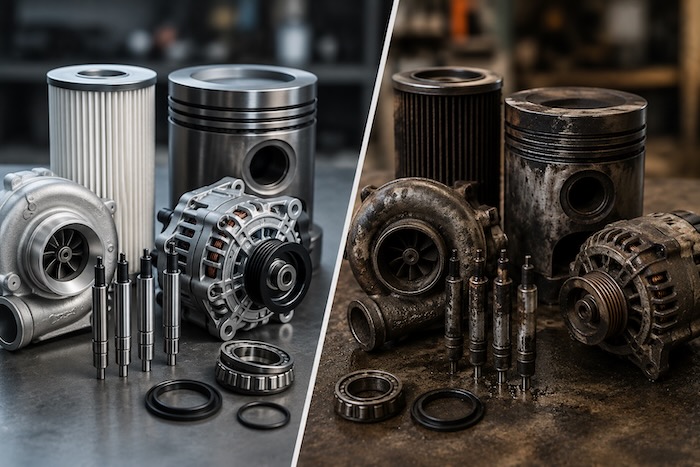
Why the advertised price is the wrong place to start
Aftermarket parts are built to suit a range of engines, not one specific engine family. That broader design tolerance is fine for simple, low-stress components. For more complex parts, injectors, gaskets, filters and turbo components, it matters much more, since DEUTZ engines are built to tight tolerances.
A part that’s slightly out of spec might run fine for a while. At the same time, it can also push up fuel consumption, run hotter than the engine was designed for, or wear the parts around it faster than it should. None of that shows up on day one. It tends to surface later, as more frequent repairs or a shorter working life for the engine as a whole.
The downtime cost nobody puts in the quote
For anyone sourcing industrial engine spare parts in New Zealand, particularly for equipment running on remote or regional sites, availability counts for as much as price. Genuine parts move through a supported distribution network, which means a known lead time and a part that’s guaranteed to fit the first time.
Aftermarket sourcing can be a false economy here. A part that turns up fast but doesn’t fit properly, or turns out to be the wrong variant for your engine, can cost far more in downtime than the saving on the part itself. For equipment that earns its keep every hour it runs, losing two or three days chasing the right part rarely pays off.
Warranty is where the numbers move fastest
This is the part of the OEM versus aftermarket decision that trips people up. Under New Zealand’s Consumer Guarantees Act 1993, a manufacturer can’t void your whole warranty just because you’ve fitted a non-genuine part; they’d need to show that specific part caused the failure. But if an aftermarket component does cause damage, the repair for that failure typically won’t be covered, and that’s where the real exposure sits. One uncovered repair can wipe out years of savings on smaller parts.
It’s worth checking the warranty terms that apply to your specific engine before making the call, rather than assuming they won’t apply in your case.
What the Five-Year View Actually Looks Like with Genuine Diesel Engine Parts
Picture two identical engines running the same number of hours. One is maintained on genuine parts throughout. The other runs a mix of aftermarket components, chosen purely because they cost less. On paper, the aftermarket engine looks cheaper every time something needs replacing. Follow it through to year five, though, and it’s typically also the engine with more unscheduled downtime, a harder time holding its resale value, and a maintenance history that takes some explaining to the next buyer.
Genuine parts are rarely the cheapest option on the day. Looked at over the engine’s working life, though, they’re usually the more predictable choice, and predictability counts for a lot when your equipment needs to keep running.
If you’re weighing up parts decisions for your fleet, the DEUTZ New Zealand team and our authorised dealer network can help you work through the specifics for your engine model. Find a nearby dealer here.