


Selecting the right industrial diesel engine supplier in New Zealand involves more than comparing price lists. Here’s a practical evaluation framework to help OEMs and fleet managers assess engine partners on capability, support, and long-term value.
What to Look for When Evaluating Industrial Diesel Engine Suppliers
The choice of engine supplier is one of the most consequential decisions an OEM or fleet manager will make. A strong partner helps you hit production targets, keep costs predictable, and stay on top of compliance requirements. The wrong one means parts delays, integration headaches, and a contact who doesn’t understand your application.
New Zealand’s operating environment has its own characteristics. Remoteness, the diversity of terrain across the motu, long supply lines from major distribution centres, and sector-specific duty cycles mean that not every globally recognised engine brand is equally well-suited to local conditions. Here is a structured approach to the evaluation.
Start with application fit
The first question is not which brands are most recognised but which engines are genuinely suited to your application. Off-highway diesel engines deployed in New Zealand’s agriculture, construction, mining, and materials handling sectors each place very different demands on a powertrain. Evaluate power range, torque curve, thermal performance, and fuel compatibility carefully.
It’s also worth asking suppliers to provide relevant references. A heavy-duty diesel engine supplier with a demonstrated track record in your sector and operating environment is a meaningfully more useful partner than one with a strong global reputation but limited local application knowledge.
In-country parts availability and lead times
Unplanned downtime is expensive, and the cost compounds quickly in production-critical environments. A supplier with genuine local inventory of genuine parts is worth considerably more than one routing everything through offshore warehouses. When evaluating, ask directly:
- What are the average lead times for your most common service components?
- Where are those parts stocked within New Zealand?
- What is the contingency if a critical component isn’t available locally?
In the New Zealand context, this matters particularly for operations in the South Island high country, Northland, or remote West Coast sites where logistics lead times already create operational pressure. A well-established OEM engine partner with genuine in-country inventory will typically outperform a newer market entrant here. DEUTZ, through its New Zealand distribution, maintains local parts support and technical capability to service customers across the country.
Technical and engineering support
OEMs integrating engines into complex equipment need access to engineers who can assist with installation specifications, cooling system integration, emissions compliance, and application-specific calibration. Before committing to a supplier, establish clearly what technical support is available, whether it’s included in the commercial relationship or charged separately, and how it’s accessed.
Emissions compliance
New Zealand’s emissions requirements are tightening. Under the Land Transport Rule: Vehicle Exhaust Emissions Amendment 2023, all heavy vehicle imports are now required to meet Euro VI-c from November 2025. Any industrial diesel engine supplier worth serious consideration should be able to clearly articulate which of their models meet current standards, and how they’re positioned to support customers as requirements continue to evolve. This is especially relevant for OEMs who export equipment or whose customers operate across multiple jurisdictions.
Lifecycle support and total cost of ownership
The purchase price of an engine is only one number in the equation. Total cost of ownership across the engine’s service life — covering service intervals, consumables, warranty terms, and end-of-life options — is the figure that actually determines value. Ask every supplier about their Lifecycle Solutions offering or equivalent: what options exist beyond standard repair, and do they include reconditioned exchange engines?
DEUTZ’s global Lifecycle Solutions framework covers the full spectrum from repair kits and Xchange engines through to complete replacement options. It’s a useful benchmark when comparing what different suppliers can genuinely offer across the life of an engine, not just at point of purchase.
A Partnership, Not Just a Purchase
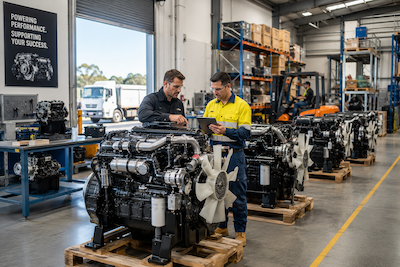
The strongest OEM engine supplier relationships go well beyond a transactional exchange. Look for a supplier with genuine sector knowledge, clear and responsive communication structures, and a demonstrated willingness to work through problems collaboratively rather than deflecting them. Asking for references from existing OEM customers is entirely reasonable and a good supplier will welcome it.
In a market as geographically spread as New Zealand the ability of a heavy-duty diesel engine supplier to respond quickly and with practical local knowledge often matters as much as what’s on the spec sheet.
Getting the evaluation right at the outset saves a great deal more time and cost further down the track.