


For New Zealand operators running hard-worked industrial equipment, diesel engine repower decisions involve more than just the repair bill. Here’s a practical framework for thinking it through.
Rebuild or Replace?
At some point in the life of any piece of industrial equipment, the engine becomes the limiting factor. The chassis is solid, the hydraulics are performing, and the machine still has useful years ahead; but the powerplant is costing more to run than it should. When that point arrives, it’s time to take stock.
Rebuild or replace? It’s a question that operators across New Zealand’s agriculture, construction, mining, and materials handling sectors face regularly. The honest answer depends on a handful of key factors.
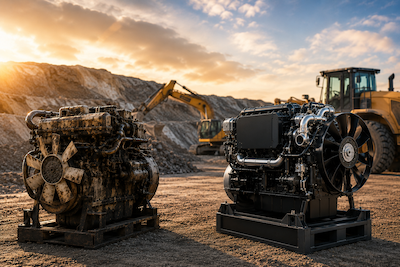
When a rebuild makes sense
A rebuild tends to be the right call when the engine’s core structure is still sound, the failure is clearly understood, and the combined cost of parts and labour comes in well below a replacement unit. Depending on the engine’s age, accumulated hours, and the nature of the failure, options can range from repair kits and reconditioned short or long blocks through to a complete Xchange engine. Engines with relatively low hours, or those that have suffered a specific and repairable failure rather than general wear across multiple systems, are the strongest candidates for a rebuild.
The rebuild case also strengthens when the machine has a limited remaining service life, or when the engine series has been discontinued. If the equipment itself is heading toward retirement within a few years, committing to a full engine replacement rarely stacks up financially.
When replacement becomes the smarter call
Once multiple systems are worn simultaneously; bore, piston liners, bearings, fuel injection, cooling; the economics of a rebuild shift quickly. Labour hours multiply, parts costs compound, and there’s no certainty the finished result will match the performance and reliability of a replacement unit.
Downtime is another factor that New Zealand operators can’t afford to overlook. If a replacement unit is available from stock, it can often be installed far faster than waiting on a full rebuild. In any production environment where machine availability drives output, lost days translate directly into lost revenue.
Replacement becomes the most compelling option when rebuild costs start approaching the price of a new or reconditioned unit, or when the engine has sustained catastrophic damage. It may also be the right move for operators looking to step up from older emissions standards; such as EU Stage IIIA or US EPA Tier 2/3; to current benchmarks like EU Stage V or US EPA Tier 4 Final. As New Zealand‘s emissions compliance expectations tighten (heavy vehicle imports are now required to meet Euro VI-c from November 2025), this consideration is increasingly relevant for fleet and equipment managers here.
The Case for Xchange Engines
DEUTZ’s Life Cycle Solution programme addresses this decision directly. Where purchasing a brand-new replacement isn’t the most practical or cost-effective route, DEUTZ offers a tiered range of options: Repair Kits, Short Blocks, Long Blocks, and complete Xchange engines. DEUTZ Xchange units are reconditioned to original manufacturer specifications using genuine DEUTZ parts, 100% function-tested, and backed by warranty. The result is a cost-effective alternative to both a full rebuild and a new engine purchase; with significantly shorter lead times than a factory rebuild.
Repower: When You Need a Different Engine Entirely
Sometimes the original engine model is no longer available, or an operator wants to move to a newer emissions standard without replacing the machine. In these situations, a diesel engine repower; fitting a different engine type into existing equipment; is often the most practical path forward.
This is a growing consideration in New Zealand as older equipment approaches end of service life and compliance expectations continue to evolve. A well-executed repower extends the productive life of a machine without the capital cost of a full replacement, and with the right engine partner, the integration process is typically more straightforward than operators expect.
Making the Call
A useful rule of thumb: if the rebuild cost exceeds 60 to 70 percent of the price of a replacement unit, replacement is almost always the better decision once total cost of ownership is factored in. Beyond that benchmark, also weigh warranty coverage, expected post-rebuild reliability, and the value of minimised downtime to your operation.
For complex repower projects, working with a supplier who understands both the engine and the application it’s going into makes a tangible difference to the outcome. The right technical partner will help you avoid costly assumptions and get the machine back to work sooner.