

Balancing Solar, Wind and Diesel on NZ Job Sites
Correct DEUTZ BESS sizing ensures stable power, reduced diesel running hours and a lower total cost of ownership.
New Zealand construction projects face unique challenges: fast-changing weather, remote working locations, sustainability targets, and rising fuel costs. This is where a DEUTZ Battery Energy Storage System (BESS) becomes a practical and cost-cutting tool – especially when it is correctly sized.
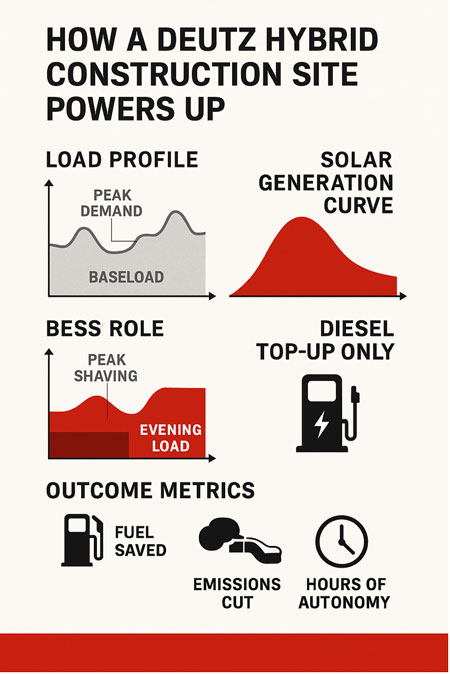
1. Start with a real, measured load profile
Before considering solar or diesel input, develop an accurate understanding of your actual load.
A typical NZ construction load profile includes:
• Peak demand: tower cranes, pumps, welders, concrete batching
• Running loads: site offices, security systems, comms equipment
• Variable daytime loads due to weather or crew size
• Start-up surges from compressors and heavy machinery
A DEUTZ BESS works best when designed around real, not theoretical, conditions. Correct load profiling prevents oversizing, reduces diesel runtime and stabilises fluctuating demand.
2. Understand local renewable inputs
NZ’s renewable conditions vary widely from Auckland to Invercargill.
Solar considerations:
• Many regions achieve 3.5–6 effective solar hours, depending on season
• Tall cranes and temporary structures can create shifting shade
• Coastal or dusty sites may see reduced panel efficiency
Wind considerations:
• Certain regions like Wellington, Manawatū and coastal Taranaki can support micro-turbines
• For most construction sites, wind is supplementary rather than a primary input
Across NZ, solar remains the main renewable source for hybrid construction setups.
3. Diesel still plays a critical role
Even with good solar, diesel is still required to cover:
• Zero-sun conditions (especially common in winter)
• Major load spikes
• Overnight baseload
• Unexpected equipment use
The goal is not to eliminate diesel but to use it efficiently.
With a DEUTZ BESS, the generator runs at optimal output rather than idling or cycling inefficiently.
Rule of thumb:
The generator should support long low-sun periods and major peaks; the BESS should manage everything else.
4. DEUTZ BESS sizing for reliability and daily cycling
For NZ construction sites we recommend planning around:
• Daily energy cycling
• Peak shaving capacity
• Autonomy during low-renewable periods
• Multi-year project duration
• Whether mobility is required (container vs trailer)
Most medium-scale NZ sites benefit from a BESS that provides:
• 70–90% of daily energy needs
• 100% evening baseload
• Peak shaving for daytime machinery
• Enough stored energy to avoid diesel overnight where possible
5. Balance solar, diesel and battery to reduce TCO
A correctly sized DEUTZ BESS can:
• Reduce diesel use by up to 50–90%
• Extend generator service intervals
• Prevent wet-stacking issues
• Lower noise and emissions
• Improve compliance with NZ sustainability and council expectations
The outcome is fewer refuels, smoother site power, and lower lifetime cost.
For support with DEUTZ BESS sizing and selection, your DEUTZ NZ dealer can model load profiles and hybrid configurations.